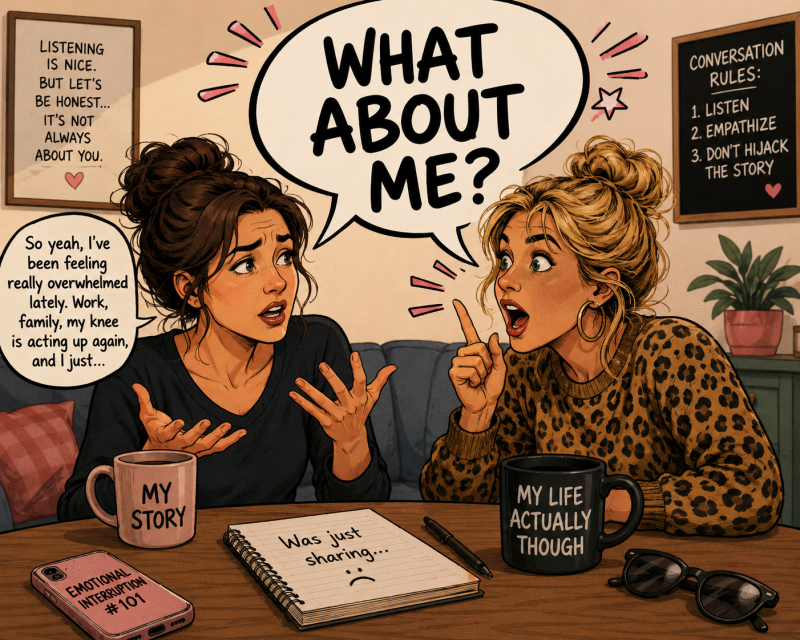
Here we go again. After my earlier blog about the eternally passive-aggressive phrase “with all due respect”, another linguistic gem has surfaced. One of those sentences that makes my skin react in places I did not even know could react. It starts off soft, almost empathetic. Harmless even. And then it quietly shifts into something else entirely. “What about me?” Blegh. There it is again.
The sentence that steals the room
These three innocent-looking words have an impressive talent for hijacking any conversation that was actually going somewhere. You start sharing something vulnerable. Maybe even something that took a bit of courage to say out loud. You are in it. You are telling your story. And then it happens. “Yeah… but what about me?” And just like that, your moment is gone. Your story, your feeling, your space in the conversation, all quietly moved aside to make room for someone else’s emotional entrance.
A small reconstruction of disaster
Picture this. You are sitting on the couch, cup of tea in hand. You say: “Well, I am having a bit of a hard time. My knee is acting up again, and the physio says I might need to stop running…” And before you even finish, your friend responds: “What about me?! I stepped on a Lego once and broke my toe. Ever since then I feel psychologically unsafe around children’s toys. Trauma, honestly.” Sorry, what? A moment that started as connection suddenly turns into improvised theatre where you have been demoted to background character in your own scene.
Let’s name the beast
“What about me?” is the Voldemort of conversation techniques. It carries this subtle message of: “Yes, that sounds hard, but let me just move the spotlight onto my situation instead.” And to be fair, it is rarely meant in a cruel way. Most of the time it comes from a genuine desire to connect, to relate, to show understanding. But somehow it misses the mark and crash-lands right in the middle of your emotional moment.
The empathy illusion
What makes it so interesting is that it often sounds like empathy. At first glance, it seems like the other person is engaging. Sharing. Relating. But in practice it feels more like: “Let me interrupt your story and replace it with my personal spin-off series.” That is not empathy. That is conversational parking in someone else’s lane without checking mirrors.
The group version is even worse
And then there is the group setting. That is where it multiplies. You are at lunch with colleagues and you say: “My cat died last week. I am really sad about it.” And then it starts. Colleague 1: “Oh no, my hamster died once…” Colleague 2: “My dog got hit by a car last year, it was awful…” Colleague 3: “I never had pets, but my plant died and I felt so empty inside…” And suddenly you are sitting in a travelling exhibition of grief comparisons you never signed up for, while you were just trying to say: I miss my cat.
Why do people do this?
It is usually not malicious. People like connection. They want to relate. And in that eagerness, they sometimes override the moment. It can also be discomfort. Not knowing what to say, so they fill the silence with their own story. Anything to avoid stillness. But still. Sometimes the best response is not a story. It is presence.
What people actually needed to say
Try this instead: “That sounds really hard.” “Do you want to talk about it?” “How are you feeling now?” Or even just: “Oh wow.” And then pause. No immediate pivot. No comparison. No emotional race for the biggest hardship. Just listening.
What about just listening?
Imagine someone tells you something painful, and you simply stay there with them in it. No interruption. No redirecting. No “but me too” detour. Just their moment. Fully intact. That is where real connection lives. Quietly. Without competition.
The conclusion
So the next time you feel that little urge rise, that “what about me?” reflex, try something different. Let it pass. Hold your own story for a moment and let the other person finish theirs without interruption. Your moment will come. It always does. And honestly, your story sounds much better when it is not squeezed into someone else’s sentence halfway through.
PS: Feel free to share this with that one friend, colleague, or relative who always manages to steer every conversation back to themselves. Subtle hint? Absolutely. But hey… what about me?
Add comment
Comments