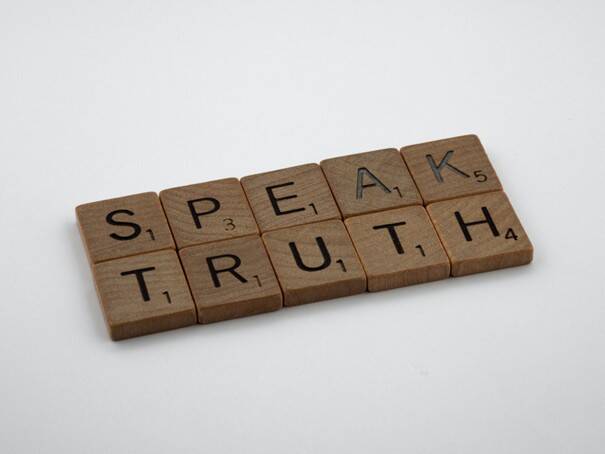
Why is the truth so uncomfortable? Because the naked truth often feels like a cold shower. Refreshing, yes. Necessary, absolutely. But also slightly painful and deeply inconvenient. Most of us are not exactly liars. Let’s not go that far. We are more like professional truth softeners. We take reality, wrap it in polite language, add a decorative bow, and hope nobody notices the original shape underneath.
And let’s be honest, we do that mostly to make life easier for ourselves. Because saying the real truth out loud sometimes feels socially dangerous. Like there is an invisible alarm system waiting to go off the moment we stop performing politeness. So instead, we improvise.
The social translation system we all secretly use
A colleague asks: “Are you coming for drinks later?” And in a perfect world, you would say: “No, I am going home because I am tired and I have absolutely no emotional or financial capacity for small talk today.” But that is not what comes out. What comes out is something like: “Oh wow, that sounds lovely! I would love to, but I already have so much to do at home.” Which is not entirely a lie. But it is also not the truth. The truth is simpler. You just do not want to go. Your brain has already left the building and is currently on the sofa. And your bank account is also quietly nodding in agreement. We do this everywhere. Birthdays, dinners, work events, social obligations that somehow multiply like laundry. “Let me check my schedule.” Translation: I hope something cancels itself for me. We are not being dishonest. We are being socially fluent. But it does raise a question. Why does honesty feel so difficult when the truth is usually so simple?
The fear behind the polite version
We soften the truth because we are afraid of consequences. We do not want to offend anyone. We do not want to ruin the mood. We do not want to be the person who says “no” and suddenly becomes emotionally responsible for everyone else’s disappointment. So we perform politeness like it is a survival strategy. But imagine, just for a second, what would happen if we said what we actually meant. “No, I am not coming to your housewarming. I want to stay in my pyjamas and watch something meaningless.” Or even better. “No, I do not want cake. I still have emotional memories from your last baking experiment.” The world would not collapse. Probably. It would just get… quieter. And more honest. And slightly more chaotic at family gatherings.
And then something changes somewhere around your forties
Here is where things get interesting. Because somewhere along the way, usually around your forties, something shifts. It is not dramatic. There is no ceremony. No official announcement. No certificate of emotional liberation. But suddenly, you care less. Not in a careless way. In a free way. You stop negotiating every opinion, every invitation, every expectation like it is a diplomatic treaty. And instead, you start thinking things like: Do I actually want to go?
No? Then I will not go.
It is almost suspicious how simple it becomes.
The long apprenticeship of caring too much
Let’s not romanticise it too quickly though. In your twenties and thirties, most of us are deeply invested in being acceptable. We are constantly running internal checks:
Do they like me?
Am I funny enough?
Am I interesting enough?
Do I belong here or am I accidentally standing in the wrong social group?
It is exhausting. We adjust ourselves constantly. Like we are editing a version of ourselves that fits better in other people’s expectations. And slowly, without noticing, you start living more for approval than for yourself. Not because you want to. But because it feels safer.
And then the switch flips
And then one day, it just… stops mattering as much. You realise something quietly radical. Most people are not thinking about you as much as you thought they were. They are thinking about themselves. Their lives. Their problems. Their own slightly chaotic grocery lists and unread messages. And that realisation is strangely freeing. Because suddenly, you are allowed to be just a person. Not a performance.
The unexpected benefits of not caring as much
This is where the real shift happens. Not into indifference. Into clarity. You start prioritising differently.
You choose rest without guilt.
You choose honesty without overexplaining.
You choose people who feel easy instead of people who require constant emotional maintenance.
And something interesting happens. Life gets lighter. Not perfect. Not suddenly organized. Just lighter. Less stress about impressions. Less energy wasted on pretending. More space for things that actually matter to you.
What honesty looks like when it finally feels safe
Once you stop being afraid of every reaction, honesty changes shape. It stops being sharp. It becomes simple.
“I cannot make it.”
“I do not feel like it.”
“This is not for me.”
No essays. No emotional cushioning. No unnecessary explanations that somehow turn a simple no into a legal document. And here is the surprising part. Most people survive it. Some even respect it. And the ones who do not… usually were not really asking for your truth anyway.
How to slowly step into it
If you are still in the phase of carefully managing everyone’s expectations, there is no need to rush yourself into radical honesty overnight. Start small. Notice what you actually want before you answer.
Pause before you automatically say yes.
Experiment with slightly more honest versions of your answers.
And most importantly, observe what happens when you do not over-explain yourself. Because most of the time, nothing dramatic happens at all. Just a small internal shift. More space. Less noise.
The strange freedom of being less available
There is a point where you realise something slightly funny. You were never actually required to be this available. Not for every plan. Not for every expectation. Not for every invitation that quietly drains your energy while pretending to be social glue. You just thought you were. And once you see that, you cannot fully unsee it.
The quiet conclusion nobody warns you about
The truth is uncomfortable because it removes performance. And that feels exposed at first. But eventually, it becomes something else entirely. Relief. Because honesty is not about being brutally direct all the time. And freedom is not about not caring about anyone anymore. It is about stopping the constant translation between what you feel and what you think you are allowed to say. And somewhere in that space, usually a bit later in life, you discover something very simple. You do not need to be for everyone. Just for yourself. And that turns out to be more than enough.
Add comment
Comments